
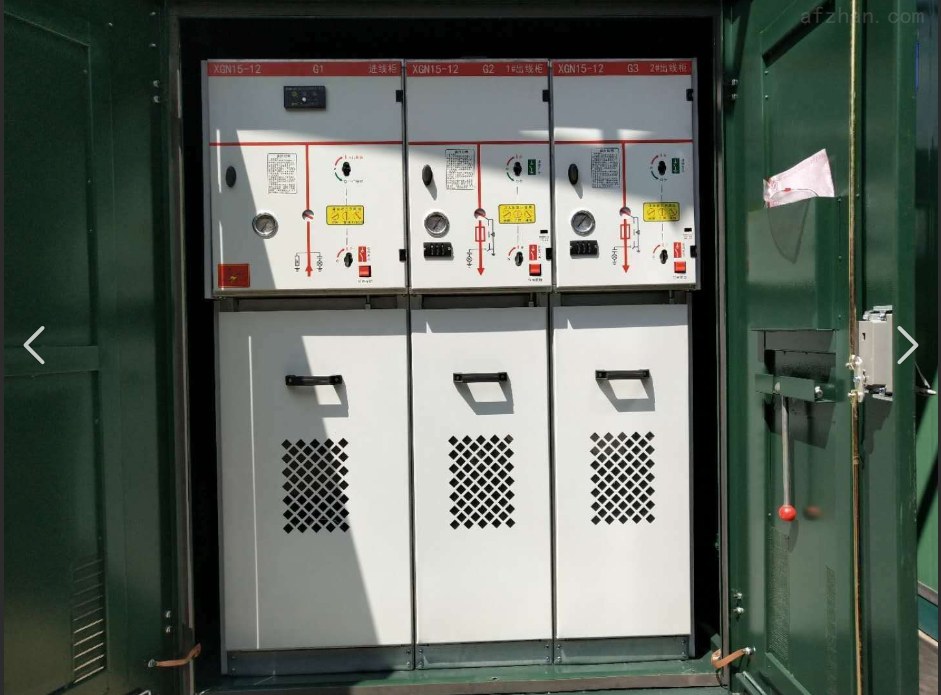
. Overview
With the advancement of cableization in distribution networks, when independent loads of relatively small capacity are densely distributed, cable branch boxes can be used for multi-branch cable connections. Cable branch boxes are not designed for direct operation on each circuit but solely serve as cable branching points. Their primary function is to split or transfer cable connections.
1) Cable Splitting Function. On long-distance lines, multiple small-section cables often result in wasteful usage. Therefore, it is common practice to employ a main large-section cable for outgoing lines toward the load, and then use a cable branch box near the load to split the main cable into several small-section cables, which are then connected to the load. This wiring method is widely used in urban power grids for applications such as street lighting and small-user power supply.
2) Cable Transfer Function. On relatively long lines, if the cable length cannot meet the line requirements, cable joints or transfer boxes must be used. Typically, intermediate cable joints are employed for short distances. However, for longer lines—especially those exceeding 1,000 meters—if multiple intermediate joints are present, cable branch boxes are often introduced for transfer purposes to ensure safety.
The cable distribution box is widely used outdoors, integrating isolating switches, high-voltage live displays, and lightning arresters. It can also be equipped with secondary components such as temperature and humidity controllers.
II. Implementation Standards
GB1985 AC high-voltage disconnector and earthing switch
GB11032-2010 AC gapless metal oxide surge arresters
DL/T620-1997 Overvoltage protection and insulation coordination for AC electrical installations
GB/T16927.1-1997 High-voltage test techniques - Part 1: General test requirements
GB/T11022-1999 Common specifications for high-voltage switchgear and controlgear
GB4208-93 Degrees of protection provided by enclosure (IP code)
JB/T 10840-2008 High-voltage alternating current metal-enclosed cable tapping switchgear
III. Conventional Technical Parameters
1. Recommended Technical Parameters Table for Cable Branch Boxes
|
Rated voltage (kV) |
12 |
40.5 |
|||
|
Rated current (A) |
400 |
630 |
630 |
1250 |
|
|
Rated frequency (Hz) |
50 |
50 |
|||
|
Rated short-time withstand current (kA/4s) |
12.5 |
20 |
20 |
31.5 |
|
|
Rated Dynamic Current (Peak) (kA) |
31.5 |
50 |
50 |
80 |
|
|
Power Frequency Withstand Voltage |
Phase-to-Phase and Phase-to-Ground |
42kV (1 minute) |
Phase-to-Phase and Phase-to-Ground |
95kV (1 minute) |
|
|
Isolation gap |
48kV (1 minute) |
Isolation gap |
110kV (1 minute) |
||
|
Lightning impulse withstand voltage (kV) |
75 |
185 |
|||
4. Ordering Instructions
Please provide the following parameters when placing an order:
1. System rated voltage: (kV);
2. Rated current: (A);
3. Enclosure type: Indoor or outdoor;
4. Cabinet material: Cold-rolled steel plate or stainless steel;
5. Shell color: Customized according to user requirements;
6. Number of incoming and outgoing circuits: Provided by the customer;
Note: Other requirements from the customer can be discussed in person or provided in writing when placing an order.